

The watch industry is increasingly defined by familiar shapes and perpetually similar and “safe” colour palettes, however, Chronoswiss has often veered in their own directions and the Strike Two Terra takes a different path again.
Rather than chasing trends, Chronoswiss has built upon one of the brand’s longest standing signatures – the regulator display. Combined with a smaller case size and laser-engraved dial with an earthy colour tone, the Strike Two Terra represents the next chapter in Chronoswiss’ modern collection.
The Strike Two Terra is one of six variants within the Strike Two collection, representing a modern interpretation of the regulator display that has become synonymous with the brand.
Oliver Ebstein, CEO of Chronoswiss explains the idea behind the Strike Two Terra:
With the Strike Two Terra, we wanted to bring the horizontal regulator into a more elemental world. The timepiece takes inspiration from the raw textures and earthy tones of natural landscapes, while staying true to the mechanical architecture and independent spirit of Chronoswiss. It is a grounded, powerful expression of Modern Mechanical watchmaking.
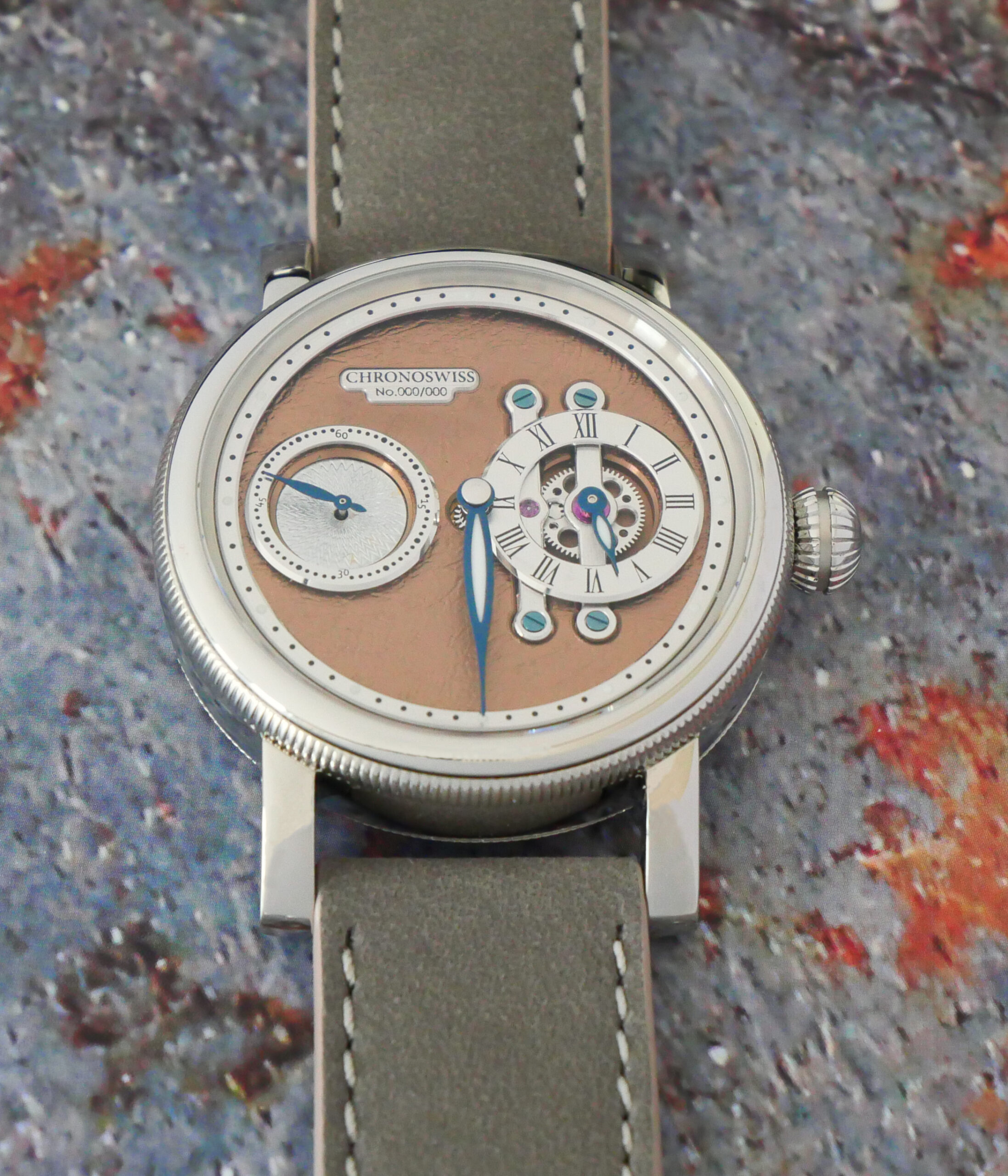
Chronoswiss Strike Two Terra
Face & case
The Strike Two Terra features a 40mm (17 part) stainless steel case measuring 12.7mm thick and combines polished and brushed finishes; it also includes several signature Chronoswiss design elements, such as the fluted “coin edges” around the top and bottom of the case and oversized fluted onion crown. Both the front and rear of the watch are protected by sapphire crystal.
The regulator display separates hours, minutes and small seconds across three individual displays, with the central minutes hand providing the primary time indication. A wide bezel frames the dial; the inner minute track being in the same metal and finish, with black dot minute markers for the majority, however, every five, a white lumed dot replaces the black.
Moving inwards, the dial is multi-layered; the main dial surface is produced using a laser engraving process, creating a textured surface finished in an undulating terracotta brown colour with a satin shine to it. The dial is split vertically in 2, with a seconds dial on the left, encapsulated by a metal ring showing the seconds scale. The centre of this sub dial has a silver coloured disc in it with a geometric guilloché, producing additional visual interest.
The hour dial sits on the right hand side of the main dial, with more prominent design features than the seconds dial; the slightly larger hour ring is marked with black Roman numerals and sits on the top layer of a few elements. Directly below, are two vertical bridges set into the main dial. One is located in the centre, the other to the left; both with with blued screws that sit outwith the hour ring and secure the bridges inset into the main dial surface and purple jewels in their centres. Below that, an inset cog with different sized circular perforations is visible, which connects to the minute hand.
All 3 hands are blue, with the hour and central minute hands having lume filled centres.
The only other thing to note is a plate between 10 and 12 o’clock on the top left of the dial, which has the brand’s name and the number of the watch out of 100 (the one in the image is a working prototype, hence the numbering 000/000).
From the sides, the lugs which appear straight from above are curved down to follow the wrist shape. The sides are hollowed out sightly, with the strap fitting screws tucked in out of immediate sight.
Flipping the watch over, the movement appears bigger than the dial does; probably because the dial has the metal ring inside the rehaut. Around the outside various engravings can be seen regarding the manufacture of the piece (including the fact the watch is water resistant to 3 ATM (30m)), but more interestingly is the movement, where various finishing methods are apparent.
The majority of the movement is a mid satin grey colour, thanks to the ruthenium-plating. This is contrasted with highly polished silver and gold coloured wheels and cogs, as well as purple jewels and polished screws. Côtes de Genève radiate out from the centre, with skeletonised bridges and anglage apparent, as well as an openworked tungsten rotor, which has the CHRONOSWISS name proudly engraved in caps taking up more than a third of the total rotor width.
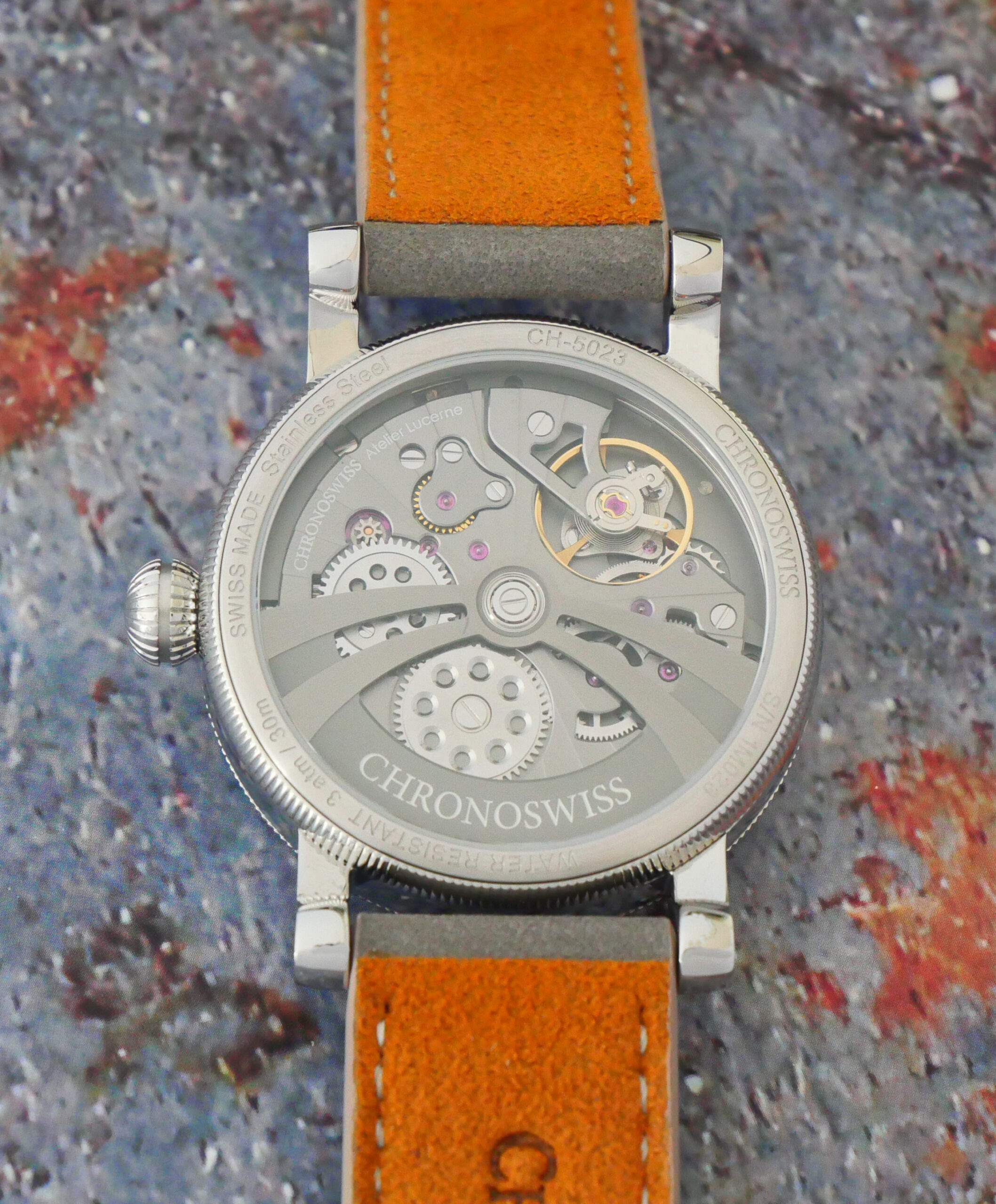
Chronoswiss Strike Two Terra Caseback
Movement
Powering the Strike Two Terra is the Chronoswiss Calibre C.6000, a manufacture automatic movement developed (in collaboration with La Joux-Perret), which actually first appeared as the C.6004 in the Delphis in 2023.
The movement operates at 28,800 vibrations per hour (4Hz), contains 31 jewels and provides a power reserve of approximately 55 hours once fully wound.
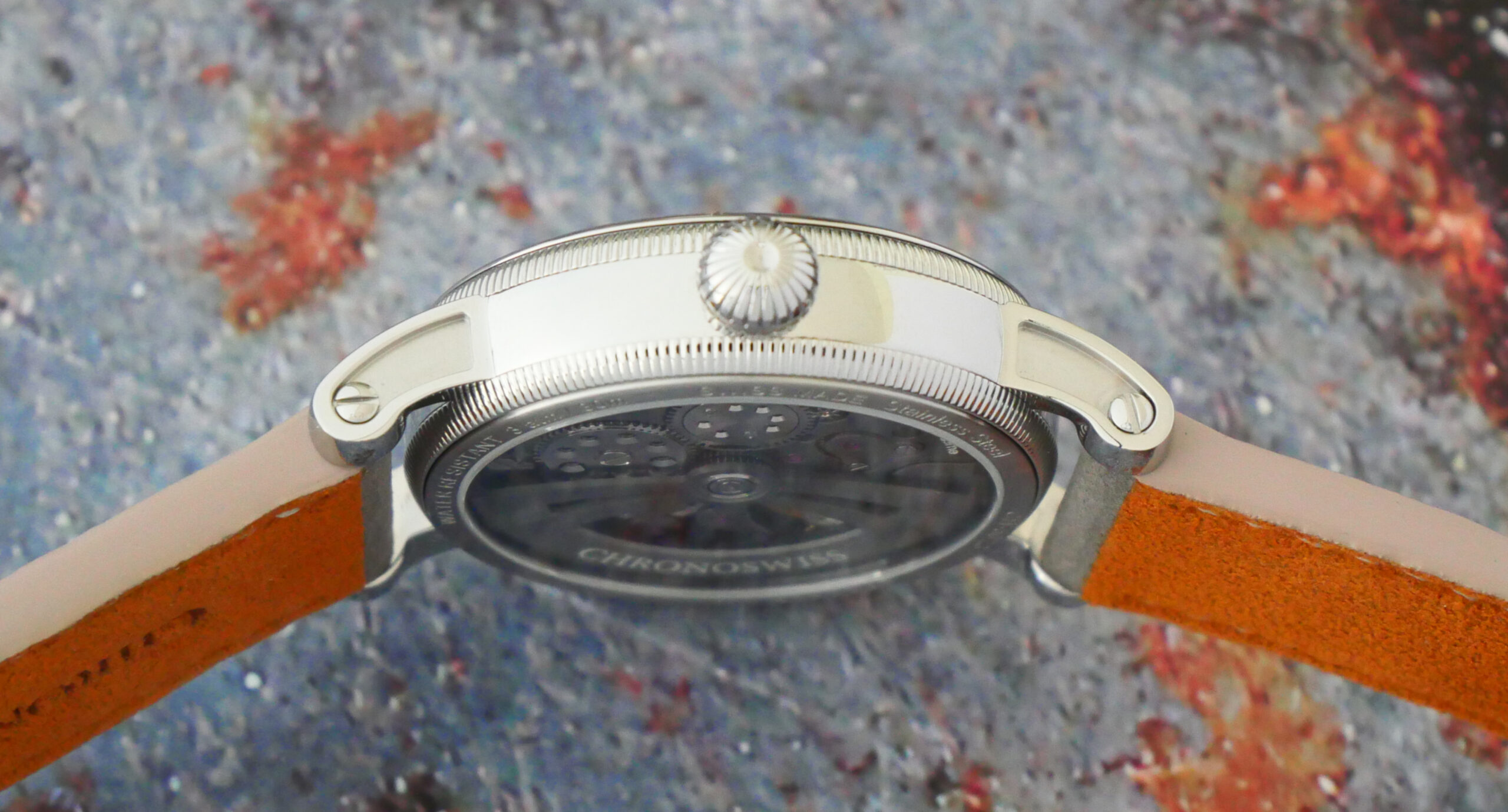
Chronoswiss Strike Two Terra Side & Crown
Strap
Supplied on a thick, grey, grained calf leather strap with a rough appearance, but smooth finish, it has lighter grey stitching and a reddy, tan coloured suede internal surface, with the usual branding embossed in black.
The stainless steel half butterfly clasp has a neat appearance, with polished and brushed surfaces. There is a bubbled flute finish on one edge and the CHronoswiss brand across it. The clasp has a micro adjustment function within it, which allows for (don’t quote me on this) maybe 5-10mm adjustment.
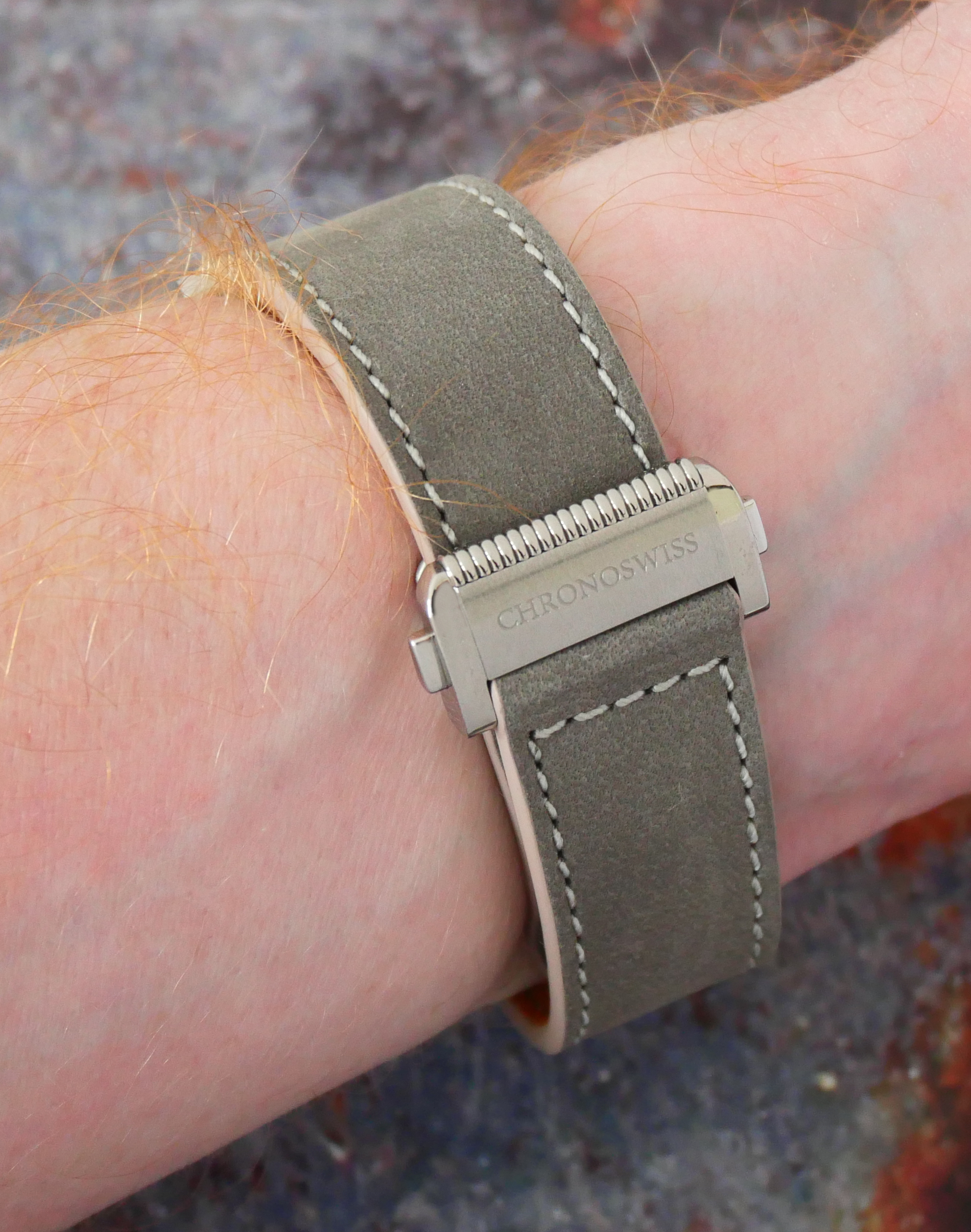
Chronoswiss Strike Two Terra Strap & Buckle
Other stuff
Founded in Munich in 1983, Chronoswiss has built its identity around one complication more than any other: the regulator display. While the concept dates back to precision regulator clocks used by watchmakers, Chronoswiss was instrumental in bringing the layout to the wristwatch, making it one of the brand’s defining characteristics for more than three decades.
The original Chronoswiss Régulateur was launched in 1987 and became the world’s first serially produced wristwatch with a regulator-style display, separating the hours, minutes and seconds, with the minutes indicated centrally. The watch also established several design elements that remain associated with Chronoswiss today, including the fluted bezel, onion-shaped crown and straight lugs.
The regulator has subsequently provided the basis for a number of more complicated watches from the brand. In 2001, Chronoswiss introduced the Chronoscope, the first automatic chronograph to incorporate a regulator display, while earlier models included the Régulateur à Tourbillon, combining the layout with a tourbillon.
Chronoswiss changed ownership in 2012 when Swiss entrepreneur Oliver Ebstein and his family acquired the company and relocated it from Munich to Lucerne. An in-house guilloché and enamelling atelier was established there in 2014, adding these traditional dial-making techniques to the work carried out by the company in Lucerne.
The regulator remains a central part of the modern Chronoswiss collection, although its execution has evolved to include three-dimensional dial constructions, retrograde indications and a wider range of materials and finishing techniques.
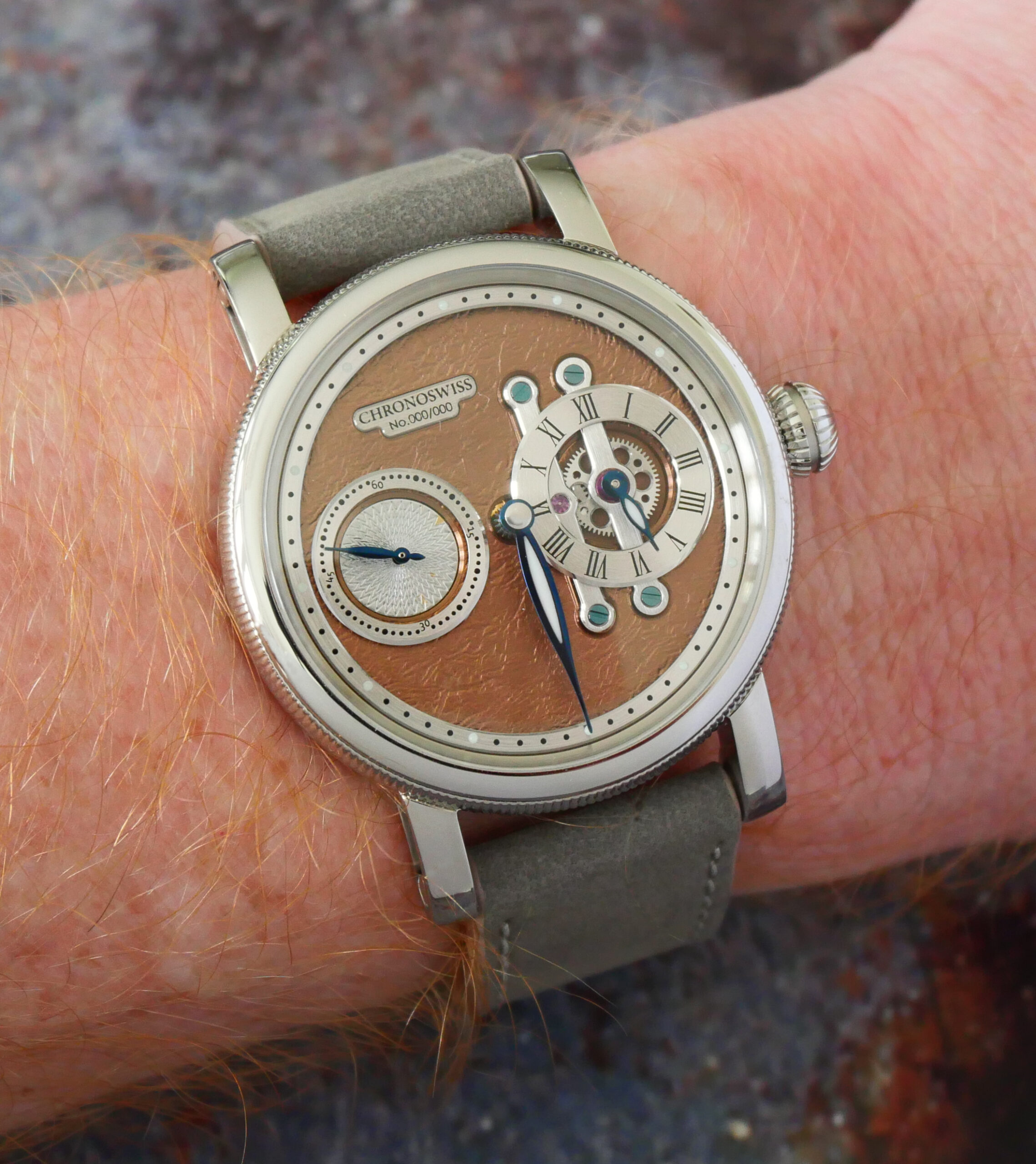
Chronoswiss Strike Two Terra On the Wrist
Our verdict
I have been a fan of Chronoswiss for a number of years, originally being drawn to the quite openly outrageous colours and designs the brand has been known for over the years. Whilst the Strike Two Terra has a much more conservative appearance and uses more muted colours, the core of the brand seems to be fully intact, using colours and a dial finish that aren’t usually seen amongst established Swiss watch brands.
The last written Chronoswiss review I did was back in 2020 and was of a wild black and yellow Flying Grand Regulator. The watch design was along similar concept back then, using regulator time telling as the core, but bigger at 44mm and much more brave in both colour use and unapologetic styling.
Apart from feeling more reserved than I was originally drawn to, one thing I did notice about the Strike Two Terra, was the movement being so much better in appearance than I remember in previous collections; the C.6000 feels so much more composed and the finishing is so much more refined.
On the wrist, the watch is 40mm, which regular readers know is verging on small for my personal preference and added to the fact the bezel and inner minute track bringing the size of the dial inwards, it does feel small to me. In my opinion, it wears more like a 37-38mm, which I know is very much the sweet spot for many collectors these days. Fitting under the cuff is probably not going to be an issue, thanks to the rounded case edges.
I always try and add an objective negative in these reviews, so I should say that I was actually a bit confused by the colour of strap; the grey didn’t work for me – I feel like the terracotta lining colour would have been a better match to the dial, but hey, that’s just me!!
With regards to pricing, value for money is there. At 9,800 Swiss Francs, we are sub 10k and the level of detail, thought, techniques and finishing that has gone into the Strike Two Terra feels strong, both from a quality and aesthetic perspective. With only 100 pieces being made, I think owners would be unlikely to see another on their travels, so adds even a bit more value if you like something different!
In conclusion, I would say this one would not be for my personal collection, manly due to the sizing, however, I fully appreciate the design and build. It feels to me as if the brand has matured over recent years and the Strike Two Terra confirms that Chronoswiss are able to straddle the void between conservative and eccentric.
We are definitely seeing more releases reminiscent of historic Chronoswiss collections and with that, I really hope that they continue experimenting with unconventional colours and extraordinary designs.
0 Comments