

From time to time, the watch world reminds us that enthusiasm for collecting and practical record keeping are not always in sync – the creation of Certainty Register came after a real world situation where these opposites unfortunately collided.
Recently, I had an unsuccessful insurance claim – the watches in question had been photographed from the dial side, but when it came time to provide proof that the items had existed prior to the claim, the supporting documentation simply was not sufficient. There were no paper receipts due to them being damaged and no other documentation of serial numbers etc.
It is a scenario that many collectors may not consider until the moment they actually need to produce evidence.
Most collectors photograph their watches – some keep neat records of receipts or invoices; yet very few maintain a structured external record confirming identifiers and that the watch(es) actually existed at a specific point in time.
Certainty Register Logo
What Certainty Register Actually Does
Certainty Register is a private digital register that allows owners to record movable assets with supporting documentation and a dated record of submission. In simple terms, it creates a time stamped record confirming that an item existed at a particular point in time.
Think of it as a structured and private inventory of the items in your possession.
Each asset entry can include multiple items of evidence – photographs, invoices, service documentation and identifying details such as reference numbers, serial numbers or other distinguishing characteristics. Once an item has been recorded, the system generates a downloadable certificate confirming that the asset has been entered onto the register with a dated record of submission. Certificates confirm that an item was recorded on a specific date, but does not constitute proof of ownership or authenticity.
The system has been designed with international users in mind. Assets can be recorded with your choice of local currency and the platform is accessible globally, allowing collectors to document assets regardless of where they are located or where the item was purchased.
Importantly, the register is not public – the purpose is not to advertise ownership or display collections, but simply to maintain a private evidential record that can be referred to, should proof ever be required.
Why It Matters
Collectors spend years sourcing watches, researching references and preserving boxes and papers. A great deal of care is taken to maintain the watches themselves, along with the documentation that accompanies them.
Yet, when something goes missing, the conversation with an insurer often becomes very straightforward – can you prove the watch existed and was in your possession(?).
Photographs and receipts can certainly help, but they are often scattered across phones, inboxes and drawers. Digital photographs may sit on an old device or cloud account, while invoices may be buried somewhere in an email archive. Paper receipts have a habit of fading, disappearing or being misplaced entirely and in more extreme situations such as fire, flooding or other natural disasters, physical paperwork can simply be lost.
Creating a structured record removes that uncertainty – instead of searching through files and folders to piece together evidence, the documentation already exists in one place with a clear dated record confirming that the item was in your possession.
For collectors, it is simply a sensible layer of record keeping that sits quietly in the background, hopefully never needed, but reassuringly available should the situation ever arise.
It makes sense to do this not only for watches, but to record all of your valuable assets in one place.
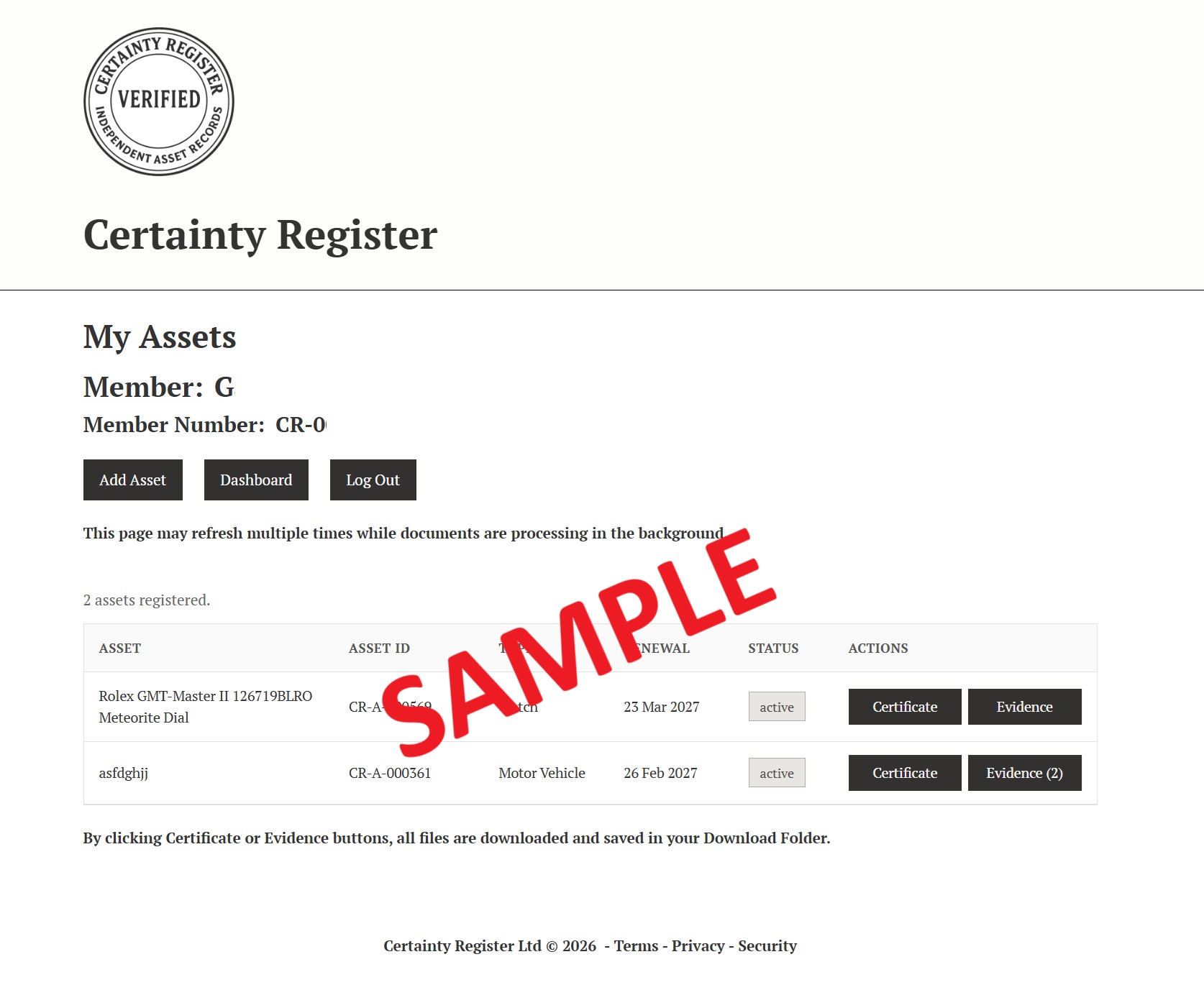
Example asset dashboard showing recorded assets and action buttons
Privacy and Security
One of the main concerns often raised when documenting valuable items is security – Certainty Register is designed with this in mind.
The system does not require any addresses, meaning the exact location of an item is never recorded within the register – each asset entry is assigned a unique set of identifiers including a Member ID, Certificate ID and Asset ID. These identifiers allow records to be referenced without exposing personal information.
For obvious reasons, certificates and identifiers should not be shared publicly.
Linking an Item During an Insurance Claim
In the event of a claim, insurers or authorised parties can confirm that a record exists by using the identifiers shown on the certificate.
The process works as follows:
The owner provides the Member ID, Certificate ID and Asset ID from the certificate.
The insurer enters those identifiers into the Certainty Register verification portal.
The system confirms the name linked to the record and verifies that the asset entry exists.
If supporting documentation is required, the owner can then authorise access to the relevant files stored with the asset record – this is a secondary and separate request which requires additional authorisation from the record holder and only if requested by the insurer.
This very controlled approach allows insurers to confirm the existence of an item through multiple secure stages, without exposing unnecessary personal information being held by Certainty Register.
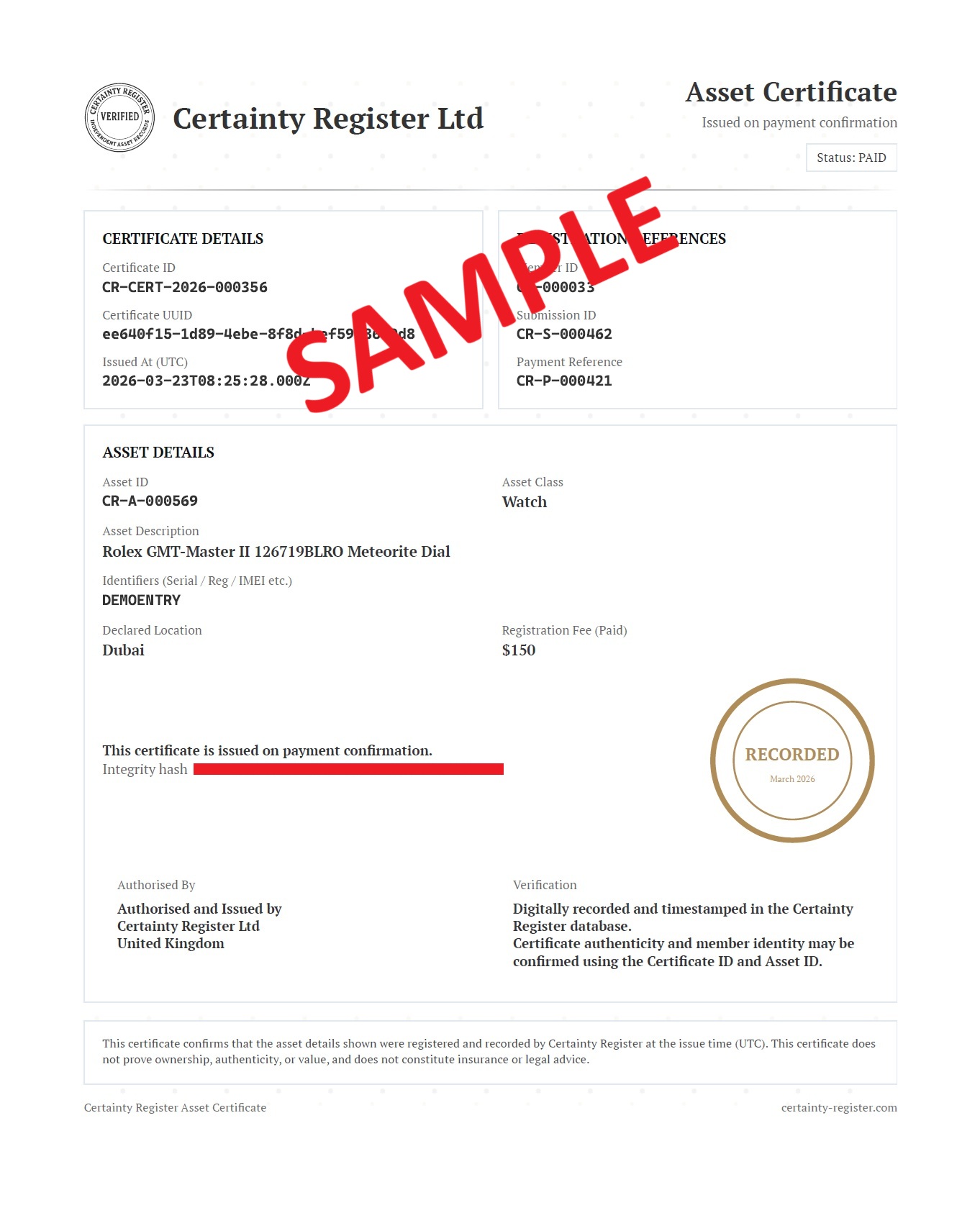
Example certificate issued when an asset is recorded on Certainty Register. Identifiers partially obscured for security.
Our Verdict
Recording an item within Certainty Register is deliberately straightforward and its efficiency is admittedly biased – the intention is simply to make it easy for asset owners to maintain a proper evidential record of the items in their possession.
For most collectors, documentation is rarely the most exciting part of the hobby – watches are meant to be worn and enjoyed, but as collections grow in value and rarity, maintaining a clear record of ownership becomes increasingly sensible. This is not supposed to be a replacement for insurance, but an additional layer of “comfort” should the worst happen.
A big factor for me is that Certainty Register operates independently and is not affiliated with insurers, dealers or manufacturers – this independence is important, as the register simply records the existence of an item without influencing questions of ownership, value or authenticity. And the fact that the address of where the asset is located is not shared with Certainty Register, gives added comfort that the database is not open to criminals to simply find a shopping list of items at a particular address!!
Pricing is set at a flat rate of £12/$12/€12 per asset, per year, regardless of asset value, making it inexpensive to document everyday items, equivalent to just £1/$1/€1 per month for the security of additional proof you had the item – there is no recurring monthly cost.
Certainty Register is not designed to interfere with the enjoyment of collecting – its purpose is simply to ensure that if proof is ever required, the record already exists and it is an easy format for your insurer to review.
Sometimes the most useful things are the ones you hope you never actually need – everything is crossed!
https://www.certainty-register.com

0 Comments